Peckham Experiment 1
FIRST PUBLISHED IN 1943
Reproduced by kind permission of the Pioneer Health Foundation. The text has been scanned by Luke Kelly who volunteered for this tedious job and to whom we are grateful. In one or two places it is corrupted, and if you can suggest corrections we would be grateful.
The Pioneer Health Foundation exists to disseminate the ideas of the Peckham Experiment,and offers the ‘Mary Langman Prize’; an annual award for an essay that furthers the lessons learnt at the Pioneer Health Centre about the social, emotional and environmental contribution health.
Social Medicine Vol 4 no 3 contains some useful articles about the Peckham Experiment
Footnotes have been incorporated into the text in [square brackets]. Photographs, which were collected together, have been inserted into what seems the most appropriate point in the text.
AUTHORS' NOTE
This book has been written to afford an approach for the intelligent layman to the growing content of the modern science of human biology. In the coming years we are all going to discover that we must either learn to understand and live in obedience to the laws of biologythe science of living thereby coming to live more abundantly : or that by ignoring them our misfortunes must multiply till, heaping up, they ultimately destroy man's civilisationand even man himself. The substance of this book has been drawn from the inspiration of and experience gathered under the Directorship of Dr. G. Scott Williamson, Halley Stewart Research Fellow, at the Pioneer Health Centre in Peckham. It is the third of a sequence of four books, of which the first two"The Case for Action"[Pearse and Williamson (Faber &. Faber, 1931)] and "Biologists in Search of Material" [Staff Report, Pioneer Health Centre (Faber & Faber, 1938)].have already appeared, and the fourth"Science, Sanity and Synthesis"on the scientific principles upon which the experiment is based, is yet to follow. It was the good sense and generous co-operation of the member-families of the Centre which has made such an experiment possible at all, and if any reader finds in the pages of this book that which interests, pleases or illumines him, it is to the members of the Centre, who lived through some difficult as well as many "grand days", that thanks are due.The work that this book represents was contributed to by every member of the Centre's staff, the observations of each having been woven into a whole by the authorsa doctor and a biologist 'curator' on that staff. Much trouble has been taken to ensure that nothing important to the issue should be omitted, and that the balance of the whole should be preserved in accordance with the facts and happenings as they occurred in the course of the experiment. For her unflagging interest and work in this connection, we wish to express our deep sense of gratitude to Miss Mary Langman, who nominally acting as amanuensis has actually contributed to every page of this book.
The money for the Peckham Experiment has been raised by a Committee of lay people, who have carried a heavy burden of anxiety in finding the necessary funds for experiment on so large a scale. The scale of the experiment was determined by the needs of health; for experience has already taught us that health can only come forth from mutuality of action within a society sufficiently mixed and varied to provide for the needs of mind and spirit as well as of body. The authors trust that all those whose vision and generosity have led them to support the Pioneer Health Centre will see in this book some realisation of their hopes.
The writing of this book has been made possible by a grant from the Halley Stewart Trust, for which the authors wish to express their appreciation.
Innes H. Pearse, Lucy H. Crocker
CONTENTS
Historical Chapter
- Living Things
- Man in the Making
- Basic Technique
- The Health Centre
- Health Overhaul
- findings of Overhaul
- New Member families
- The Family Grows
- Infancy
- School Days
- Growing Up
- Courtship and Mating
- The Birth of a Family
- Social Poverty
- Social Sufficiency
- A Community Grows
Appendices (mostly tables and diagrams in picture form)
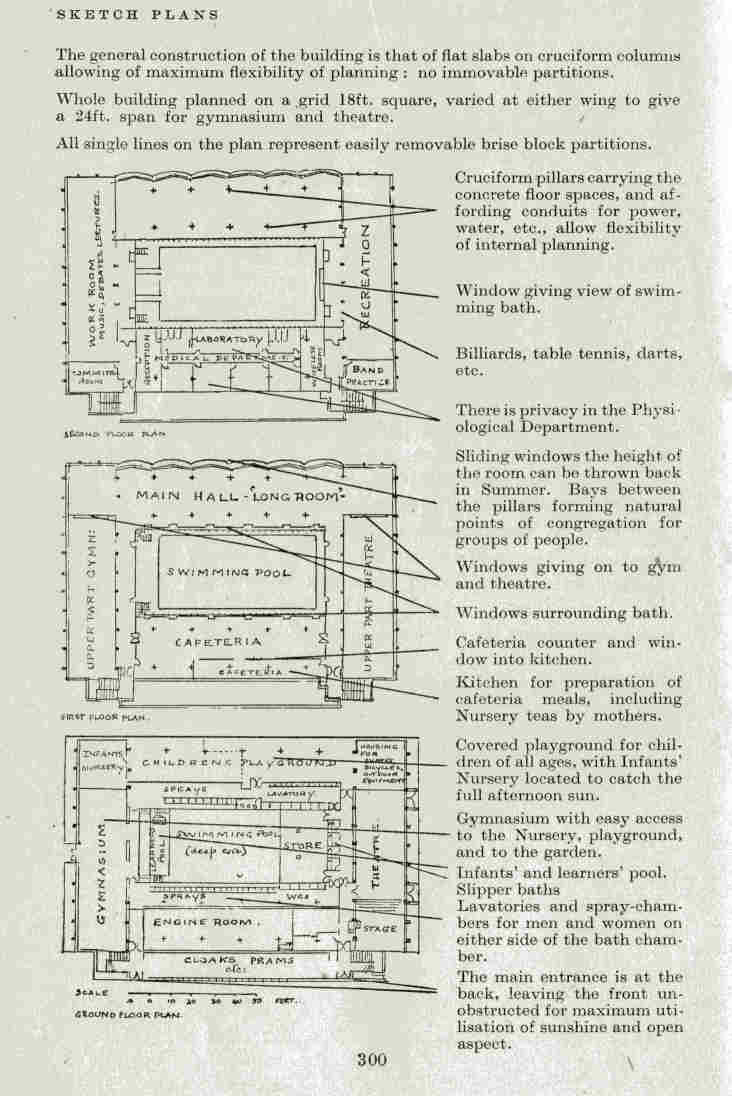
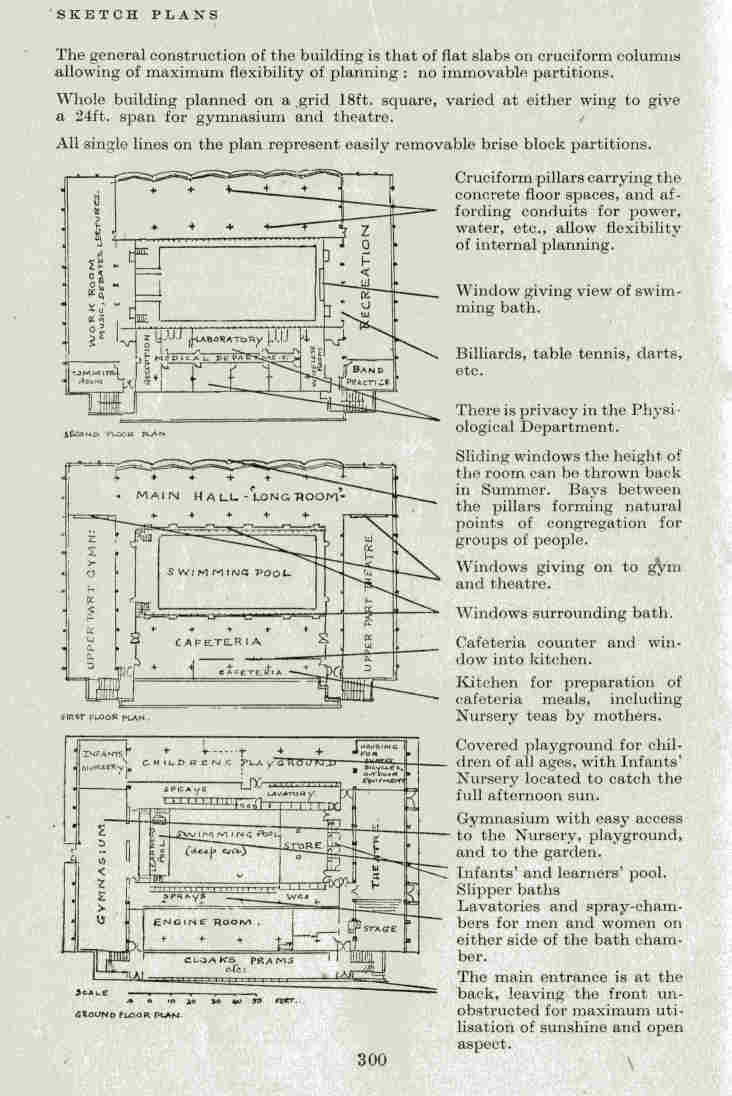
- Plan and Notes on the Building
- Services and Amenities
- Nature of Employment of members part 2 part 3
- Specimen of Laboratory Records Tonoscillogramme
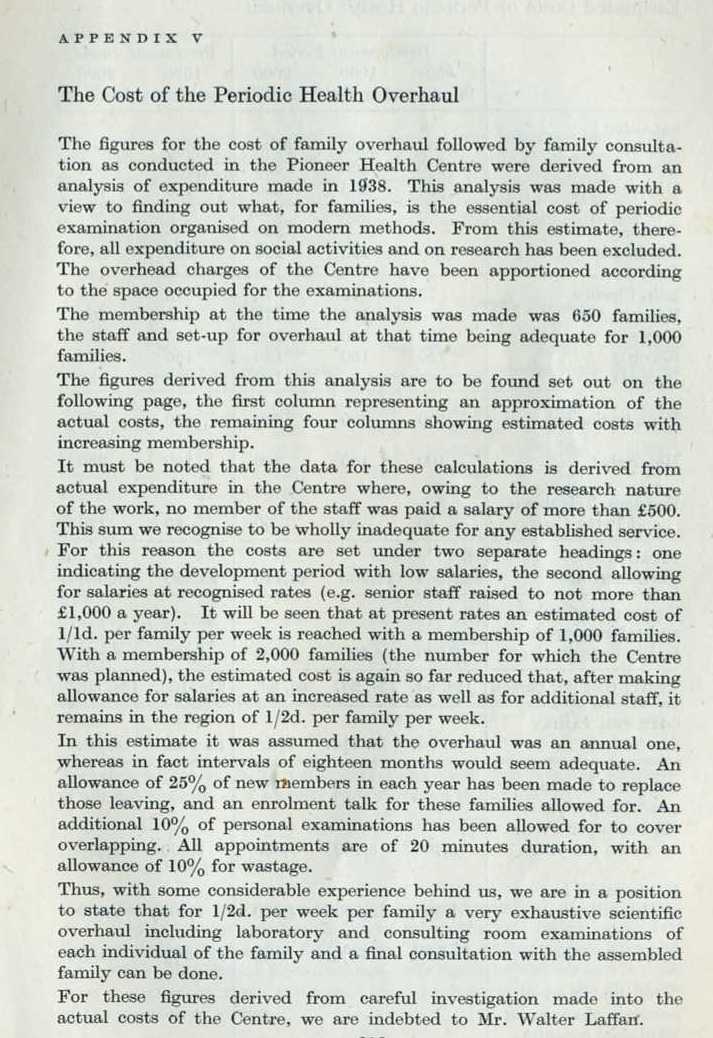
- Cost of Health Overhaul Table
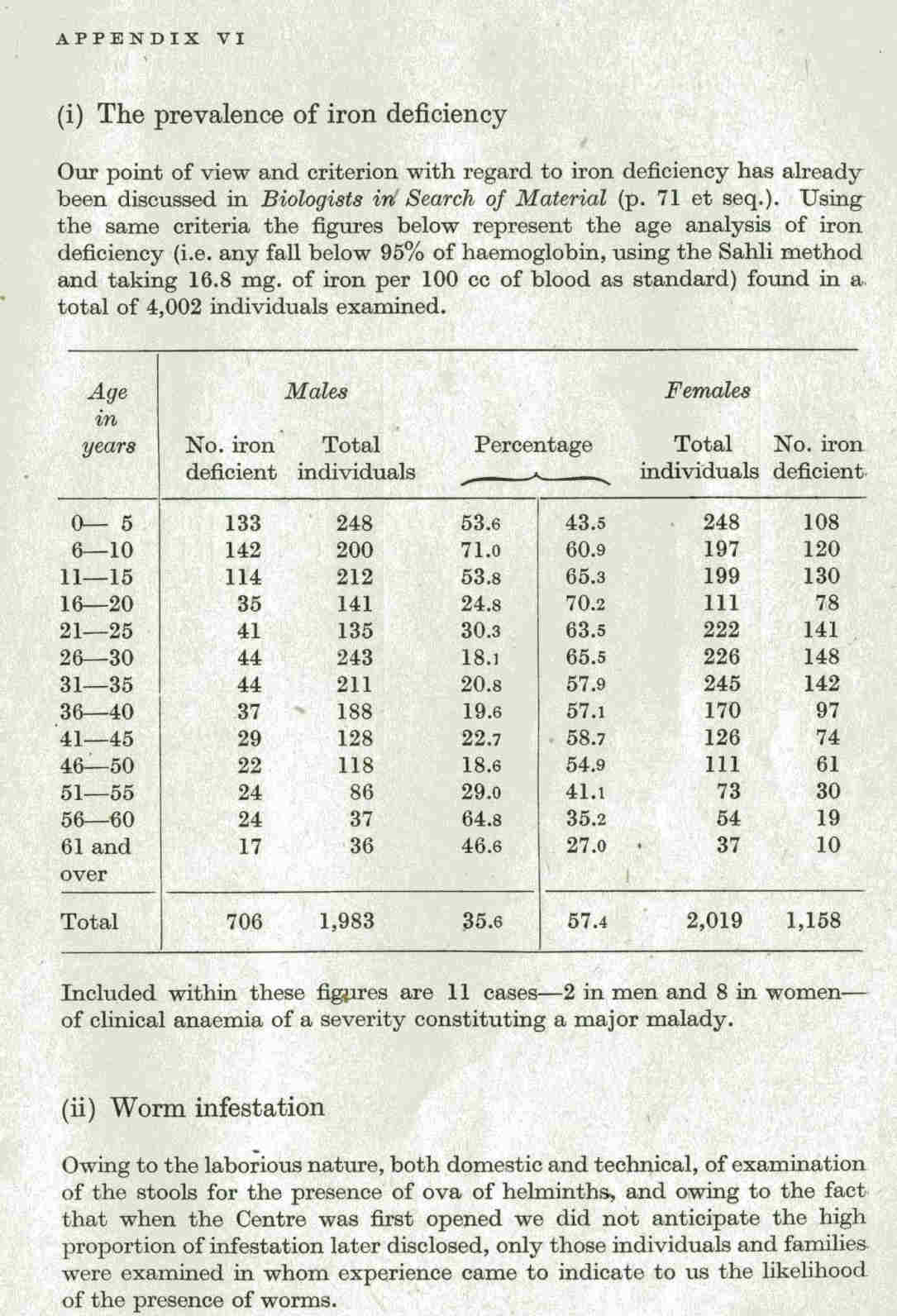
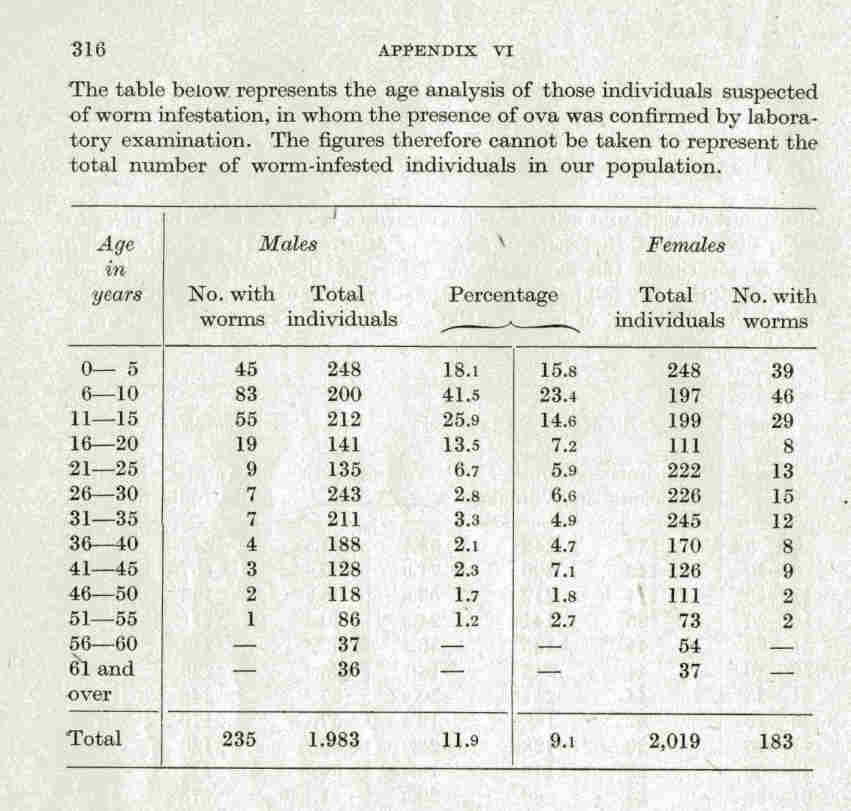
- Prevalence of Iron Deficiency and Worms
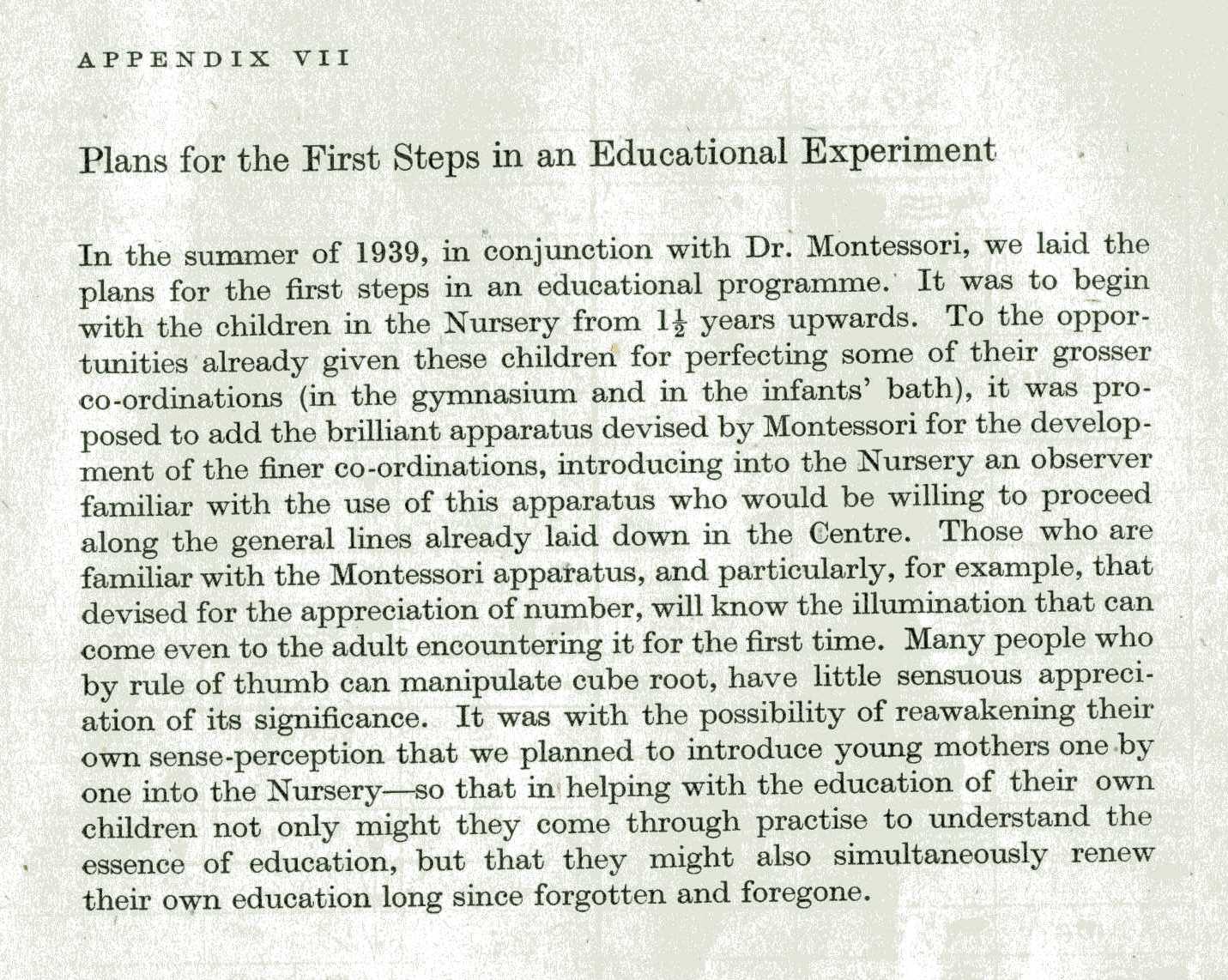
- Plans for an Educational Experiment
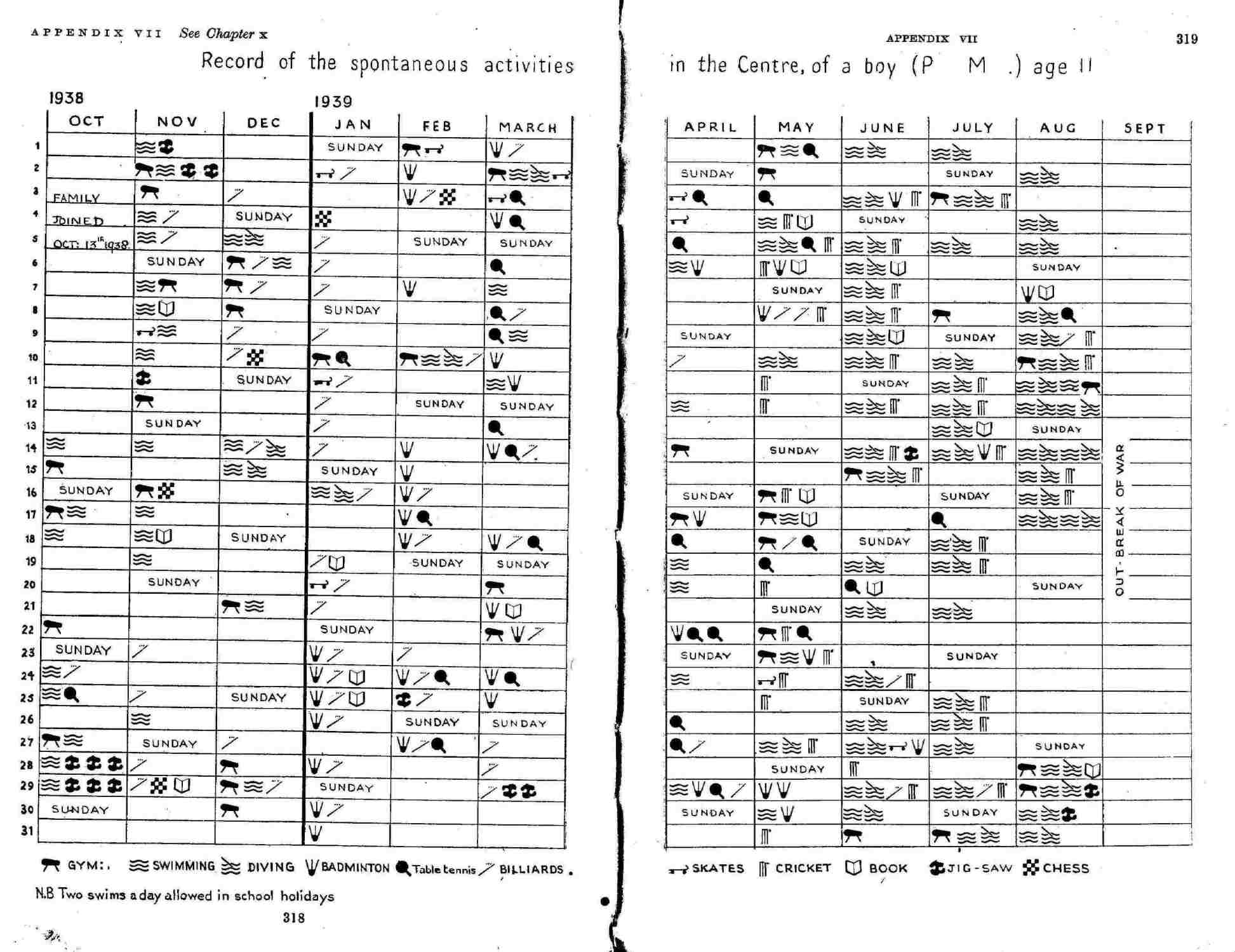
- A Child's Activities
- Financial and Administrative
- Use of the Centre daily and weekly notes
To those in despair of Man's civilization
A PARABLE
A lawn, a rabbit hutch, a much loved rabbit hopping about free in the sun. Its owner, a little girl, has heard a noise that fills her with dismay. She rushes out to find that the terrier from next door has escaped into her garden . . . loud barkings, a horrifying scuffle. The inevitable is happening. . . she flings herself to the ground, for she cannot see that dreadful end. Minutes pass, blackness, abysmal horror, when faintly a voice reaches her, "It's all right, Jennifer, the rabbit's safe". The child uncovers her face ; slowly she approaches the hutch: no cry of joy; she turns away in contemplation. Five minutes later she is heard saying to herself. . . "I must remember, always have a good look before, you cry".
HISTORICAL
Before beginning to build, it is necessary to know what bricks are to be used, or, in modern terms, what must be the unit of construction. Times and fashions change and with them the units of material construction. So, too, with the constructs of Society; man changes his institutions, his customs and the external circumstances of his life and, in a manner, his own life with them. But Nature's laws are abiding. In the realms of Matter and Energy about which man has come to know so much, he accepts Nature's units of construction and works in obedience to her laws. In the realm of Living he has yet to recognise the unit with which Nature works ; and to learn to use that unit. If man is to venture on the rebuilding of Society, he must take nothing for granted. The first question therefore isWith what unit does Nature build in the living world? It is with the answer to this question that this book is concerned, and because that is its subject we publish now what would in less turbulent times have been withheld until the studies that underlie it had reached a fuller measure of maturity. We claim to have defined the unit of Living. It is not the individual; it is the family. This has opened up a new field for experiment into social organisation and has enabled us to contrive the first rude instrument for the exploration of new possibilities. It is not then on theoretical grounds alone but with some basis of experiment and experience that we offer to the student concerned with the structure of Society of the future, an indication of what living unit will give us a living human Societyno matter what variations in detail may be necessary to suit different peoples and different climes.
In Science one thing leads to another. When setting out on a journey of exploration no scientist knows what his ultimate destination may be. Studies on the ill-defined fringes of several branches of Science, particularly that of pathology, have led to new light being thrown, not on Sickness, but on Health. The first indicating finger pointing to the necessity for the study of health came from work on the epidemiology of infectious disorder.
So in 1926 the pioneer "Health Centre" took shape. [For an account of the first Health Centre, and of the sketch plans for the second, see The Case for Action, Pearse & Williamson. (Faber & Faber, 1931). 2s.] A small house was taken in a South London borough. It was equipped with a consulting room, receptionist's office, bath and changing room, and one small club-room. Families living in the vicinity were invited to join this Family Club for a small weekly subscription. By the end of three years, 112 families, i.e., some 400 individuals, had joined and all the individuals of these families had presented themselves for periodic health overhaul. Not all had retained their membership throughout that period, but the question had been answered. Under suitable circumstances, there were families who would welcome a Health Service distinct from any sickness service and without being urged by any sense of impending sickness. But perhaps the most outstanding fact learnt by the scientific staff was that although sickness could be detected early, often indeed long before the individual had any idea of its presence, and although it was found that the individuals subject to such disorders were willing and anxious to have them removed and with the assistance made available now took the necessary steps for their removal, it was in many cases useless to eradicate the disorder only to return the individual to the environmental conditions which had induced it. Equally important, it was discovered that in those who manifested no disorder, the standard of health or vitality found was low and could not be raised without suitable equipment for the purpose. In other words, it became clear that while operating efficiently as a sieve for the detection of disease and disorder, periodic health overhaul is ineffective as a health measure in the absence of instruments of health providing conditions in and through which the biological potentiality of the family can find expression. This finding was unforeseen. The issue now became greatly complicated. The possibilities both for the study and for the cultivation of health were opening out and taking on a new aspect. It was decided to shut down the first small Health Centre which was, as it were, a bench test, and to devise an experiment in which not only the technical measure of periodic health overhaul could be employed on a larger scale, but in which there would be available circumstances and material likely to kindle the health of the families examined.
The Pioneer Health Centre, Queen's Road, Peckham, London, S.E.

Seven long years passed. They were spent in planning the next stage in great detail and in collecting money for a new and larger enterprisea field experiment it might be called. It was to be a Health Centre to cater for 2,000 families, in which were to be offered consultative services as before, and in which the member-families would find equipment for the exercise of capacities for which there was little or no possible outlet in the ordinary circumstances of their lives. Thus in 1935 the second stage of the Pioneer Health Centre took form. It was a great venture: a social structure to be built with a new unitnot the individual but the family.After eighteen months' work an interim report was published under the title of Biologists in Search of Material.[ Faber & Faber, 1938. 2s.] In that book many details of the initial procedure, including the technique followed in the periodic health overhaul, were given. These we do not propose to repeat here, for many will have read them, while for those who have not, the report is still available. We must, however, emphasise the major conclusion of that report. It was that the Health Centre with its peculiar technique for dealing with families in a social milieu with simultaneous use of the periodic health overhaul, had provided us with an instrument of analysis not unlike a prism, which interposed in a beam of white light analyses it into its component parts giving a picture of the spectrum, or rainbow. The spectrum that the Centre revealed was, alas, no gay coloured rainbow. It made clear that the populace was composed of three categories:
- those in whom disorder was accompanied by disease 32%
- those in whom disorder was masked by compensation, and who therefore appeared in a state of 'well-being' 59%
- those in whom neither disease, disorder, nor disability were detectedthe 'healthy'9%
The mechanism of the Pioneer Health Centre has made it possible to view and to study discretionately, in the light of these several categories, so-called 'normal' families and individuals going about their daily business.[ Biologists in Search of Material, p. 78]
As the experiment has proceeded, the understanding of the scientific staff has deepened, and the theory of Health has been developed and clarified. We can now visualise the essential elements of a technique for the practice of Health as something different and distinct from the practice of Medicine. It is with this subject that the greater part of this book is concerned. The first three chapters range over a wide field, affording a sketch map of the territory into which we are being led, and indicate the principles of growth and development that are beginning to stand out as fundamental to Living. To some, these chapters may seem difficult, leading them into realms with which they are little familiar. Those readers may prefer to skip this portion of the book and pass on to what for them may seem a more human aspect of the experiment, only returning later to the theoryas one returns to the map at the end of a day's journeyto trace the path along which they have travelled through a close-woven chronicle of human circumstance.
So vivid was the life, so illuminating the understanding that came to those who worked and moved in and with the experiment, that it remains unalterable. The war, passing like the black shadow of an eclipse across the world, has caused the experiment to be suspended, [The Centre's activities were suspended at the outbreak of war, September, 1939, owing to the inevitable dispersion of the family unit in war conditions,] but live and vibrant beneath what is now a scorched earth, "the Centre" lives to thrust up in a new age. It has already proved itself a 'living structure'.
CHAPTER I LIVING THINGS
Living cannot be interpreted in terms of material-dynamics. Some other cosmic principle is at work not included in and not defined by the laws of matter or of radiation, however "deep the waters" into which the study of these have led. "The universe can be best pictured, although still very imperfectly and inadequately, as consisting of pure thought, the thought of what, for want of a wider word, we must describe as a mathematical thinker". [The Mysterious Universe, Sir James Jeans. (Cambridge University Press, 1930), p. 136.] Possible though it is to conceive of thought without personal attributes, that concept is nevertheless impossible divorced from the quality of livingness. But this picture does not disclose to us the nature of the livingness behind thought; it only implies that when the laws of Living are disclosed they may demand yet one more co-ordinate on our graphs and yet another mathematic even more intricate than the last.
Setting out as biologists to study Living, we shall not attempt to define the nature of Life any more than the physical scientist defines the ultimate of Energy, but merely proceed to examine its manifestations in the living entity and to determine the laws that underlie its operation.
But for the manifest of Life we have as yet no exact name, that is to say, we are not any more discriminately aware of its nature and identity than man must always have been of the sun's rays before Science began to work its own magic with them. So, before proceeding to grope our way forward in the study of the manifest of Life we must name it. Throughout this book we propose to call it 'function'.
Appropriation of the word 'function' for the manifest of Life raises with workers in other fields of Science an issue demanding clarification. The physiologist, long first in the field in the study ,of the mechanism of the living body, uses the word 'function' freely, and in our understanding indiscriminately, to cover several distinguishable operations of organism not all of which are significant in the study of living. To illustrate this we might refer to one of the common technical procedures of the physiologist where, by excision or other means, he isolates organs from the general influences of the body in which they occur, and fixing their environmental conditions, proceeds to observe their 'functional' response under given stimuli. Perhaps the best known and extreme example of this type of procedure is the excised chicken-heart which was kept beating in a bottle some twenty-five years after the death of the chicken. This heart ceased to beat and 'died' owing to a single oversight in which there was failure to adjust the perfusing fluid,evidence that its 'survival' was dependent upon the rigid fixation of its environment.This brilliant experiment gives us information about the mechanism of heart muscle, but it gives none either of the functioning heart or of the living chicken. It is not unlike the information gained from the bench test of an internal combustion engine. A bench test is a valuable test, but it gives no indication of the final performance, for example, of an aeroplane in flight,a tool in the hands of a skilled pilot instant to adjust the machine to the least suspicion of environmental change. The conditions imposed upon the engine by the will of the living pilot in response to changes he encounters in the environment will to a very large extent nullify the value of the information gained from the bench test for what is commonly called 'practical' usefor which the engine was in fact invented. Certainly the inferences to be drawn from the performance of the engine in these two circumstances are not identical. With most physiological studies this is no less true; they yield information about the body but not about its 'living'.
So, two distinct and different studies may be made: one of the responses of organism, organs or tissues in a controlled, artificial or fixed environment-physiological operation; the other of the behaviour of the living organism as a unity in an ever changing and free environmentbiological function. It is for the latter that we shall consistently reserve the word 'function' in this book.
The next step is to determine through what unit function is manifest; and where and how it can most easily be studied. A unit is the smallest 'parcel', aggregate or organisation which exhibits the characteristic attributes of any substance, potency or entity. Technically, living entities are called 'organisms'.
Before therefore, we can answer these two questions, a further question must be asked: What is an organism? By 'organism' we understand any living entity capable of performing the full cycle of its specific existence. Not all living entities fall within this definition. For example, a soldier-ant is a living entity but it is not an organism, for alone it is unable to complete the cycle of ant-hood. In the ant species various operations integral to ant are delegated to various entities in the heap. The queen alone can lay eggs; the soldiers protect the queen; the workers feed her, etc. Each entity has its own special work to contribute to the organism, and without that contribution the function of ant is abrogated and continued life in the organism, 'ant', ceases. [See The Soul of a While Ant, Marais. (Methuen).] The ant-heap alone represents the full range of function of ant-hood. It is then the ant-heap that represents the unit-organism 'ant'. Similarly, it is the hive of beesnot the single bee representing a specific operation essential to the hive, or colonythat forms the organism 'bee'.
"And for their monarch Queenan egg casting machine Helpless without attendance as a farmer's drill, By bedels driven and gear'd and in furrows steerd Well watched the while, and treated with respect and care - So long as she run well, oil'd stoked and kept in trim". [Bridges. The Testament of Beauty. (Clarenden Press, 1929], p.55.]
Bridges knew the Queen to be but the ovarya mere organ of the organism'bee'. But here in the hive of bees there is so extreme a degree of separation of the respective organs of the whole organism that the casual observer has been deceived into regarding each bee as a separate organism.
Seen from the same aspect of function, two frogs, male and female, compose the organism 'frog', for though one frog or one soldier-ant is an integral part of the organism 'frog' or 'ant', neither alone represents the unit-organism capable of the full functional cycle of their species. This is so obvious that it may be wondered why we stress the point. It is, however, of the greatest importance to the student of function, for were we to study bull-frogs or soldier-ants alone, in ignorance of their connection with the facultative species 'frog' or with the ant-heap, we should never arrive at a knowledge of the full functional capacity of their respective species. The part cannot declare the function of the whole.As students of function in man (homo sapiens) we must then at the outset be careful not to take anything for granted: not to mistake the individual for the whole organism, for, as we have seen, the individual may be but an organ of a more complex organism. By a mistake of this order we should be doomed to miss the manifestations of function that we are seeking. In studying the mechanics and dynamics of the human body this point is not of the same critical significance. For instance, the student has merely to make an adjustment for the sex of the individual studied, to arrive at a knowledge of the mechanism of the body of the species. If he is conversant with the anatomy of a man it will servewith the addition of facts about the difference in weight, shape, structure of bone, etc., together with a knowledge of the difference in the sex organsfor a knowledge of the anatomy of the human species. What knowledge he has of the biochemistry of the alimentary system can be applied with success to either sex indiscriminately. When we come, however, to function, this method no longer serves, for we find that man and woman are not functionally identical entities exhibiting merely superficial differences aligning them for cooperation, as in the reciprocity of mechanism; not merely two entities with capacities so nearly equivalent that they can shoulder the same tasks and by means of a statistical correction be regarded as interchangeable units, as, for example, in the 'science' of economics, in industry, or in the labour market. In the functional sphere man and woman do not work reciprocally as in mechanism, but mutually as diverse parts or organs of a unified organism like a small ant-heap linked in the continuityor what later we shall have to call the 'specificity'of a 'functional organisation'.
After mating has occurred, invoking a new functional organisation, we no longer have a man and woman who, shackled like the links of a chain, have joined hands in marriage, but one bi-polar unitywith maleness and femaleness at its opposite poles. How can we visualise such a unity? In the physical realm it is perhaps not unlike the solution of metal within metal such as we find in some of the amalgams. Or, in the physiological realm, perhaps we are led to recall the bi-axial construction of the features of the human body: right and left handed, right and left kidneyed, right and left hearted, right and left eyed. The unity of the mated pair, dual like the body, is right and left individualled, as it were. Thus, the human organism, like the body itself, is a unity balanced in function as in feature.
The reader may perhaps find this a difficult conception to grasp; may object that any process of merging of two individualities suggests loss rather than gain, and hence is one that cannot represent the true picture of progressive human functioning. On the contrary, the new polarity of the functioning organism brings with it for each individual a measure of fulfilment unobtainable by either alone.
We know the opprobrium implied in the expression 'one-eyedness'. This is not without reason. If we look more closely at the mechanism of optics we see that each eye looking separately sees a field more limited than that covered by the two together. But this is not all. Binocular vision does not merely reproduce in a combined and enlarged picture the field of view of each separate eye. The two eyes acting as a unity create a novel image. So there emerges the 'solid reality' of a stereograph, which no one-eyed vision can achieve. What applies to vision seems to apply to all functional action : it is dependent upon duality operating in unity. So too with the mated pair we find duality operating in the unity of male and female. Hence man also is bipolar in function. There is no sacrifice here ; neither is it compromise. Just as the eyes in binocular vision produce a stereograph, an origination or novelty, so it is the 'parenthood' engendered by the unity of two diversitiesmature manhood and womanhood which originates, or brings the new to birth.
Thus when two diverse individuals function as an organism, all that they encounter acquires a new significance. It is not merely the addition of the experience of one to that of the other, making the combined view a larger whole seen, but that with new polarity a new quality is given to their apprehension. And this quality of perception is given not only to what is experienced at the moment, but that experience itself influences what they in their new functional orientation will in the future experience hence altering their every action.The supreme and most concrete example of such an origination or novelty from the fusion of two diversities is, of course, the child. It is a reproduction neither of mother nor of father ; indeed, not a reproduction at all. It is a new and unique individuality that is originated through the bipolarity of organismal function.
So it is through the unified mutual action of two entities, man and woman, that alone the full function of Man is manifest; that full and rich diversification of his species proceeds, and that human potentiality finds its full expression. Thus while the individual man (or women) is a satisfactory subject for study by the zoologist, physiologist or pathologist, only man-and-women as a unity can meet the needs of the biologist setting out to study function. [See also The Case for Action, p. 60-65.] What then are we to call this functional unity this concept of the biological unit? We have named it 'family' implying by that word the mated pair either with or as yet without children, and it is in this sense that the word 'family' will be used throughout this book.
There are other difficulties and subtle snares with which biological material confronts the student. Function is not always explicit. Like force, it may be potential or latent; that is to say, the full range of functional manifestation of the species may only become explicit in certain circumstances the nature of which we do not yet understand, and which may well chance to be absent when and as we observe. We may, in fact, only be familiar with rudimentary manifestations of function in the life of any species. In ignorance of any fuller manifestation, how easy to take these to be the full expression of its potentialities. A striking example of such a situation is to be found in the case of the Mexican axylotl, tadpole of the salamander (Amblystoma). This large aquatic tadpole can and usually does live, breed, rear its kind and die in its unmetamorphosed (tadpole) state. Only many years after it had become known to the zoologist and familiar as a fashionable parlour pet was it discovered to be merely the tadpole or larval state of a land-walking salamander catalogued as a different species. Because the axylotl was able to live and propagate its kind in its immature form, its potentiality for living a different and wider existence, for acquiring lungs and walking on dry land, was missed even by the zoologist. [It is possible in the laboratory to effect the metamorphosis from tadpole to salamander within a few days by the injection of thyroid extract. From this we must infer that the potency of endocrine secretions cannot be overestimated in their effect upon function.]
To snares of this nature the experimenter must be alive as he approaches the field of function in human biology, for he may not assume that man as we now know him is man whose potentialities have already found their full expression.We have already shown in an earlier publication [Biologists in Search of Material, p. 78 et seq.] that there are three distinct states in which man may exist while carrying on his daily life. Hampered by disorders he may suffer from the ravages of disease; cloaking his disorders by the use of his reserves, he may be buoyed up by a false sense of 'wellbeing', or, lastly, he may live a full functional existence in which his development is proceeding according to his potentiality. The difference between these three states has been shown to depend on the several relationships of the individual to his environment. In the last of these three states only, is man free to act in mutual response to an ever changing environment. It is this last state which we recognise as the legitimate field of Health or 'wholeness'. This field of Health or sanity with which we as biologists are concerned will be found to be distinct from that of Sickness, where subject to disorder the individual obeys the laws of pathology. In Health man observes a different natural law: the law of function with which we are here concerned.
It might with reason be asked:Why entertain the idea of using man, with all his complexity, as the experimental animal in what is so new and difficult a field, for surely the first necessity is to find the simplest organism for investigation? The zoologist hitherto concerned with the classification of species and the particulate description of living entities, has turned naturally to unicellular entities having little anatomical structure other than a delimitating membrane enclosing a nucleus surrounded by a body of cytoplasm, such for example as amoeba, or paramecium.[ for a popular account of amoeba see Cine-Biology, Burden, Field & Percy Smith. (Penguin 1941).] These are the simplest for his purpose. But when attention is turned to function the scene begins to shift. When the amoeba encounters food in the immediate environment the whole entity flows towards the attractive morsel; it stretches out its body in the form of embracing limbspseudopodia, surrounds the food particle, and, dragging its whole body forward in the direction of its embrace, engulfs the prize. Whatever attracts it, the appearances to all intents and purposes are identical an all-or-nothing type of enveloping action for each and every new experience embraced. How confusing to the observer this apparent similarity of expression for all the delights of life!
In order to observe functional action in its discretionate form we are forced to the opposite end of the zoological scale and it is to Man himself we turn. Man wishing to eat can take his food with finger and thumb and while doing so can carry on simultaneously many other distinct and intricate operations. Five fingers have been differentiated in his hand, each capable of separate co-ordination to effect discretionate movement; he has acquired a constant and material gullet, stomach, liver; he has a renal system and complete and well-defined nervous system, etc.all of which have acquired through age long differentiation of his species a high degree of special and independent action. The human organism then, is the most convenient primer for the biologist who as student of function seeks to elucidate the laws of living.
What of the next question? How does the biological organism or any lesser biological entity proceed to its fulfilment through function? We have been accustomed to regard the living entity at its inception and in its most primitive state, as no more than a focus of livingness in a limitless and apparently passive and wholly unfamiliar environment. There is interposed between the twothat is between the entity and its environmentno more than the semblance of a membrane created by the difference in direction and rate of two dissimilar motions. Thus we usually visualise the simple cell, amoeba. Thus we marvel at the sureness with which the unprotected speck of protoplasm, presumptively unguided and born into what is usually conceived as a 'hostile' environment, shapes and forms itself with such unfailing accuracy and, acquiring the specific features of its kind, reaches maturity. Whence comes the material for its growth and development? It is from its environment that has been presumed to be hostile.
The picture of the amoeba lured to engulf a particle of food in its nearby surrounding medium is diagrammatic of the process of accretion in all living entities. The amoeba embracing a particle from the environment, engulfs the morsel and digests it. On such meals it lives and grows. This tells us the source of its increment: all material for increase comes from the environment. It tells us nothing, however, of the method by which the individual converts the ingested environmental moiety into the substance of its own body. So, before the significance of the above picture can be understood, the fate of the engulfed environmental contribution must be followed.
Once within the body, the morsel is picked to pieces, chemically analysed, sorted out and separated. Certain selected portions are then as it were reshaped and woven into its very substance according to its specific order, thereby adding to and developing its unique basic design. This processthe living power to build up a basic organic design from the substance of the environment is called 'synthesis'. The process of acquisition is the same whether it be of food, light, or any other engulfed 'experience'. Once of the body, all is stamped with the trademark of the receiving house, part transitorily, part, and that a highly selected portion, indelibly marked or 'sensitised' with the individuality of its new host.From this 'factory' there is an enormous output, some to be sure consisting of rejected intake ; some the product of physiological work doneheat produced, etc. The higher we rise in the zoological scale the more important and distinctive becomes the other surplus of highly elaborate biological synthesis, for owing to the specificity it acquires in the 'factory' through which it has been processed, it is potent in the environment to which it is returnedleaves, fruits, hoof, skin, hair, urine, faeces, etc. In his intuitive wisdom in the past, the good cultivator of the soil has for centuries known the value of these so-called 'waste' products for maintaining fertility. It is modern civilisation that has applied the word 'waste' to them. To the physiologist also they are 'waste'a nuisancefor their excretion brings about changes in the environment which he is seeking to stabilise and fix for the conduct of his experiment. Perhaps indeed it was the physiologist's original use of this word 'waste' for goods returned from the body's factory, that has been responsible for hindering our appreciation of the significance for living of these materials returned to the environment, and hence of their significance to the future of the living organism itself.
In the field of function where individual and environment work in strict mutuality they assume an importance of a magnitude not yet recognised. For all the products of work done must be included in this categorythe objective products of the living entity's subjective process of development. When we come to Man his surplus of synthetic products cast into the environment are well nigh overwhelming, for, besides his physical excreta, there are the products of his mind and of his skill: his inventions, his music, his art, his scienceall shed fruits of his synthesis. Let an apple fall, and as a result a Newton sets in motion a train of further human synthesis that changes the face of man's world!
Thus, the environment is the source of diversity as well as the recipient of the diversification of that which is taken from it by the organism. Each different factor or change in the environment that impinges on the organism, each new food particle digested, each new co-ordination learned as a result of experience made possible by any new environmental disposition, results in the development of further specificity in the organism and leads to a still more versatile power of apprehension of further environmental contributions. Also, and consequently, it leads to still further novelty in the products subsequently received into the environment. So that in the presence of adequate nutriment, function implies an ever increasing diversification, in the organism and in the environment alike.
This is the functional picture of life in flow. It is to be seen in a progressive mutual synthesis participated in by both organism, and environment. It is wholenessHealth.
Here then is a picture not of hostility between the organism and its environment but of mutuality at work in the living world. Yet hitherto the development and indeed the very existence of the organism has been pictured by the scientist as a 'struggle' for survival [ Cf for example Man on his Nature, Sir Charles Sherrington, Chapter XII, Conflict with Nature, p. 359. (Cambridge University Press, 1940).]; while Man in his acknowledged supremacy is alleged to have 'conquered' Nature, i.e. his environment, rather than to have wooed Her in the sensitivity of a mutualor loving relationship.It is in the modern revival of ancient methods of agriculture [The testament of Agriculture, Sir Albert Howard. (Oxford University Press, 1940).] and in the science of ecology that hitherto there has been the fullest appreciation of the mutuality of function in the organism,with its essential shuttle-like throw from environment to organism and from organism to environment, each throw changing the design, each change affording a stimulus to the next change that is to follow. Yet plant, animal and man live by the same biological law. The laws that govern growth and development apply equally to the organism as a whole, or to its parts.As we have proceeded, there may have been gathering in the mind of the reader a growing speculation, perhaps an almost nervous apprehension, as to the constitution of the environment itself in this mutual transaction. Neither has this thought escaped the biologist. He begins to appreciate that the process of diversification so characteristic of organism and, as a result of the life process, equally apparent in the environment, must denote some progressive order in the latter. Can it be that the environment, also 'in process', is taking on an orientation as ordered as that which the embryologist can follow so clearly in the differentiation of the embryolike the chick developing from the amorphous material of the egg? Is, then, the process we call 'evolution', with all its manifest expressions, but one universal expression of the 'organ-ation' of the environment itself? Is the environment alive?
The mutual action of organism and environment, associated as we rise in the biological scale with an increasing degree of autonomy of the organism, recalls forcibly to mind the circumstances of a single cell, such for instance as the liver cell, set in the body of which it is an infinitesimal part. The cell acts as liver cell carrying on the specific function of 'liverness', yet always, in health, 'aware' of, and subject to, the wider needs of the body of which it is part and from which it derives sustenance. It is this relationship to the body which alone gives significance to its individuality as liver cell as well as to its unique function of liverness.
The pathologist is only too familiar with the situation that arises where this delicately poised relationship of the cell's autonomy within the sphere of a greater organisationthe body is absent. When the cell multiplies without reference to the impulses of the greater organisation of the body of its inhabitation, the result is cancer, the definition of which might be stated as 'multiplication without function'loss of individuality. Such procedure ushers in antagonism, disrupting the mutual association between the cell and its environmentand ends in the ultimate destruction of the cell, of the body in which it grows, or of both.
Thus the body as an organisation is, in fact, the ultimate significance of the cell. Can it then be that Man himself is but a cell in the body of Cosmos ; and that Cosmos is organismal as he is?
Without being able to define the factual basis for their intuition for that can only come through sciencewise men in all ages have acted with a deep intuitive consciousness of this as a truth. Upon it they have built their hopes, their conduct and their religions. Only now, as intuitive apprehension seems to be wearing thin and threadbare, are men of science being led, through the study of function, to suspect that there may even be a physical basis for these primitive intuitive actions ; that in fact the significance of human living lies in the degree of 'mutuality established with an all pervading order, Nature whether we deify her or not.
So in order to study function, we must turn to the organism and its environment, in process of mutual synthesis; the organism of choice for our study being the human family, homo sapiens. Herein then lies a challenge to adventure. The student at this point must be willing to put from him the comfortable cloister of the traditional laboratory where he has learnt the structure and the classification of species; he must leave the protected harbours of the physiologist where the merest zephyrs of the environment are steadied and controlled ; he must part company too with the student of medicine who, informed by the science of suffering (pathology), has been searching for negative evidence of function (health) in the shadow of sickness and amidst the shades of the dying. Leaving these behind him, now as biologist prepared to sail upon the open sea of humanity where the manifold winds of the environment play in ceaseless change, he may set out on a further search into the science of Living.